Pellegrini: World in Far Worse State Than a Year Ago
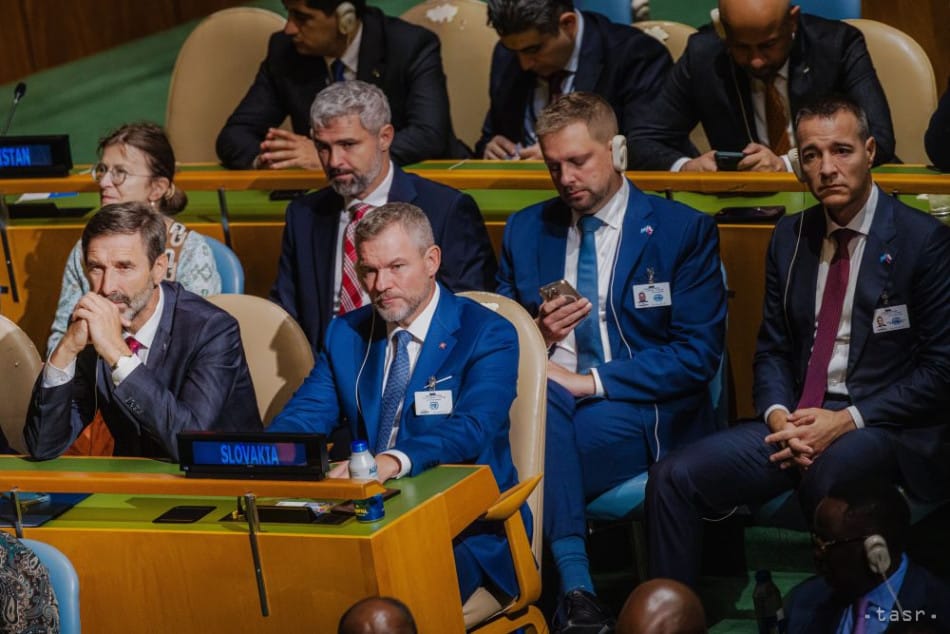
New York/Bratislava, 22 September (TASR-correspondent) – The world is in a significantly worse situation than it was a year ago, as the erosion of multilateralism and the international order has deepened further, President Peter Pellegrini declared on Tuesday after the start of the general debate of the UN General Assembly in New York, TASR special correspondent reported from New York on the same day.
Pellegrini pointed to differing views on the world's development expressed in opening speeches by UN Secretary-General Antonio Guterres, Brazilian President Luiz Inacio Lula da Silva and US President Donald Trump.
"Since the Second World War, we have had more open military conflicts on our planet today than ever before — and that does not bode well," Pellegrini noted. He identified climate change, persistent inequality between women and men, and the development of artificial intelligence as key challenges. He also described the growing concentration of power in the hands of major technology companies and individuals as a problem.
In Pellegrini's view, the use of AI-guided weapons is a crucial issue. The time has come for serious discussion about their regulation at European Union level, as he warned that such weapons systems are already being deployed in armed conflicts and may be capable of deciding for themselves which target to strike.
Pellegrini also questioned the idea that UN reform alone, a need that has been discussed in political circles for some time, can resolve the problems facing the world today. "I would venture to say that I have some doubts as to whether we are hiding the behaviour of some world leaders, who appear to have stopped acting in accordance with the UN Charter and the rules, behind the slogan that we need to reform the United Nations itself," he said.
"I believe that first we should reform the behaviour of some world leaders so that they return to respecting the law, principles and international rules, and then perhaps focus on making the organisation itself more effective," the president underlined.
He said that neither the United States nor Russia could currently assume the role of peacemakers: the US has carried out military intervention in Venezuela and against Iran, while Russia initiated the war in Ukraine. According to the president, "no war is just", and therefore he called for dialogue, saying that continuing the current approach could lead to an even greater tragedy or a global conflict.
Pellegrini also pointed to the lack of a more significant effort to halt the arms build-up. Within the EU, he expects growing debate over how long defence spending can continue to rise at the expense of healthcare, education and industrial competitiveness. At the same time, he believes that EU is not doing enough to address high energy and fuel prices. He referred to remarks by Slovenian Prime Minister Janez Jansa, with whom he'd held talks in New York earlier, that Ljubljana has already exhausted domestic options for addressing high energy prices.
Pellegrini warned that the EU must deliver concrete results or risk losing public support and its position in the world. He pointed to elections in France, Italy and Spain in 2027, which he said could significantly influence EU's future direction.