Municipalities Urge Swift Change to Fiscal Responsibility Law
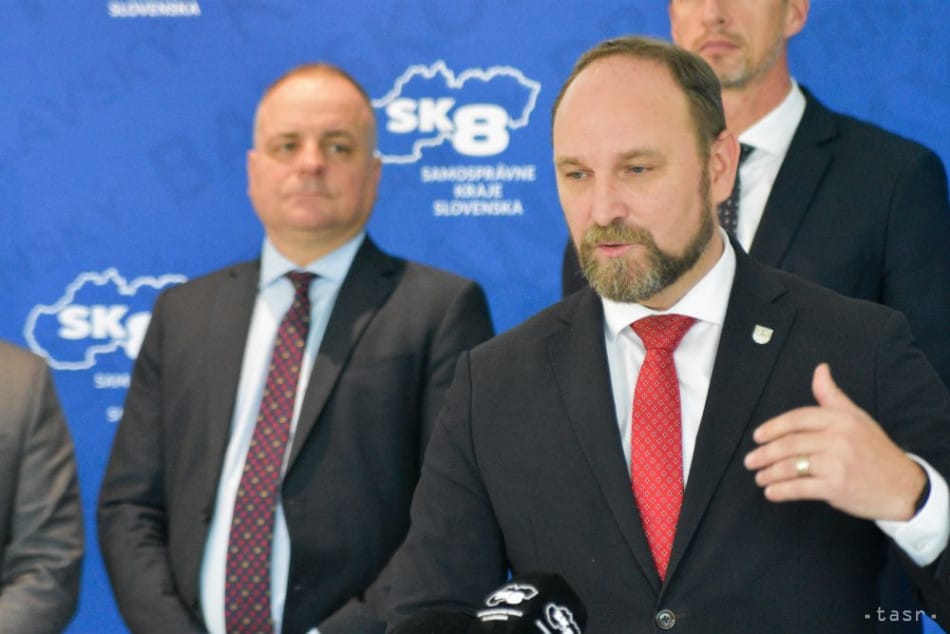
Bratislava, 24 April (TASR) – Municipalities have called on members of Parliament to urgently amend the constitutional law on fiscal responsibility, and representatives of the Association of Self-Governing Regions (SK8), the Slovak Towns and Villages Association (ZMOS) and the Union of Slovak Towns (UMS) reiterated the appeal at a press conference in front of Parliament on Friday.
They warned that if local governments aren't exempted from the sanction mechanisms of the debt brake, it will be impossible for them to draft their budgets for 2027 to 2029, and basic services for local people will also be at risk.
"Local governments are already subject to very strict control under the law on budgetary rules of territorial self-government. Additional sanctions stemming from the constitutional framework are simply duplicative. We aren't asking for exemptions or any privileged position.
We're asking for fair and rational rules that reflect reality. Specifically, an amendment to the constitutional law so that local governments will be excluded from the sanction mechanisms of the debt brake. The proposal also has the support of the Finance Ministry and doesn't in any way threaten the stability of public finances," underlined SK8 chair Jozef Viskupic.
He noted that local governments currently account for less than 2 percent of the total public debt. Despite this, the debt brake's sanction mechanisms are also applied to them, even though they didn't cause the high level of debt and can't influence it.
"We consider the current situation to be unsustainable. Under the law, local governments may only approve a budget with expenditures at the level of the previous year. At today's prices, that is simply unrealistic," warned Viskupic.
According to him, such an obligation prevents local governments from using their past savings or from taking out loans. The result may be a paralysis of investment, with the modernisation of roads, schools, and social care at risk, along with the quality and scope of basic services for local people, he emphasised.
"The issue we are raising is not one of political games or coalition-opposition disputes, but one of common sense. Right here we are again calling on all responsible politicians to amend the constitutional law, precisely because sanctions affecting towns, municipalities and self-governing regions are far greater than those applied to the state," explained ZMOS chair Jozef Bozik.
Bozik pointed out that they have been raising the issue since last autumn and have the support of both the Finance Ministry and the Council for Budget Responsibility.
"If the constitutional law on fiscal responsibility isn't amended, we'll also be significantly limited in terms of drawing European Union funds, which currently account for around 80 percent of what we see in investment projects on our territory ... If we are unable to draw loan resources and cannot use what we have saved in our reserve funds, this absorption will be significantly restricted.
This may result in us having to return funds and being unable to deliver services of the quality that our inhabitants are accustomed to," said UMS vice-president Peter Wolf.
According to Viskupic, representatives of local governments have addressed their appeal to the House chair, the chair of the public administration committee and all MPs.
"I assume that we'll hold talks at the level of individual parliamentary caucuses. The mechanism would probably be best if agreed as an amending proposal on behalf of the chairs of parliamentary caucuses, so that a constitutional majority can be found," he added.