Ruzicka: No Reason for Slovakia to Be Ashamed of Its PISA 2025 Results
Slovakia has no reason to be ashamed when it comes to its results of PISA 2025 testing, OECD Deputy Secretary-General Frantisek Ruzicka told a news conference in Bratislava on Tuesday.
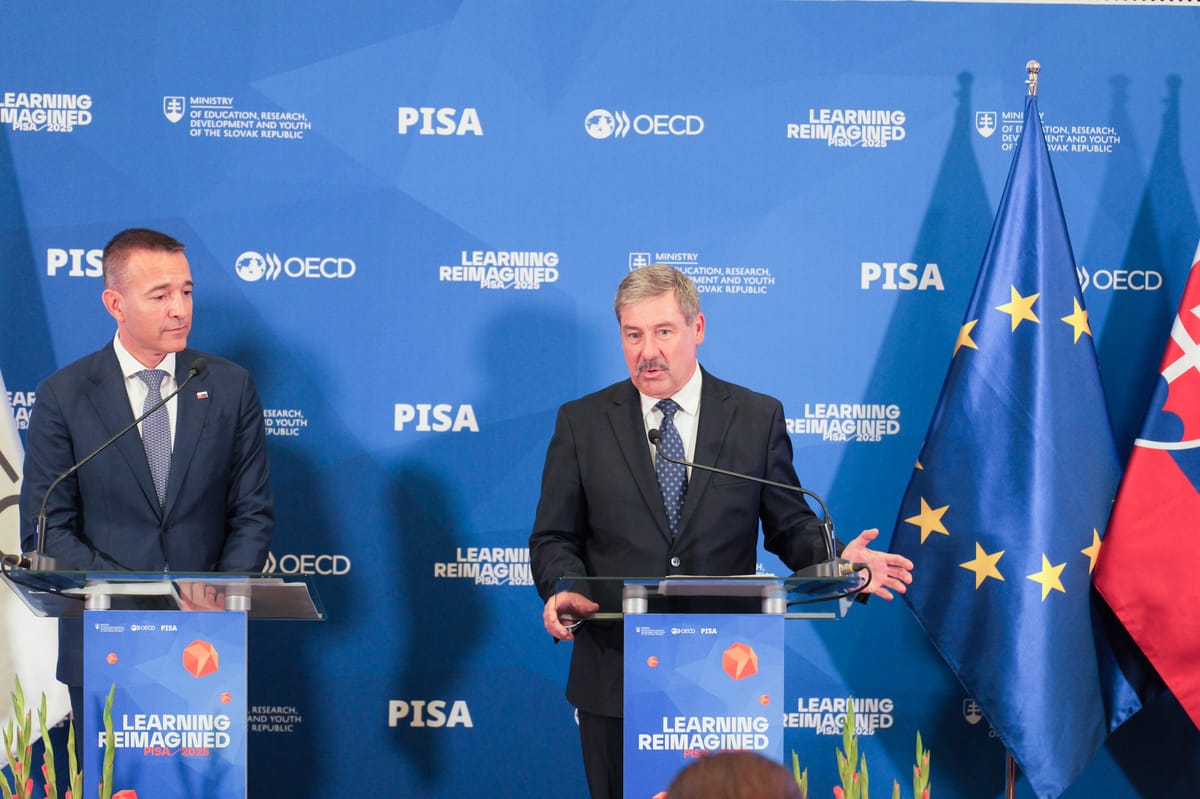
Bratislava, 8 September (TASR) - Slovakia has no reason to be ashamed when it comes to its results of PISA 2025 testing, OECD Deputy Secretary-General Frantisek Ruzicka told a news conference in Bratislava on Tuesday.
Ruzicka highlighted that Slovakia is above the OECD average in mathematical literacy and recorded an improvement in scientific literacy. However, Slovak students need to read more, he said.
Education Minister Tomas Drucker (Voice-SD) views the findings as a reflection and an encouragement.
The average reading literacy performance across OECD countries was 461 points, while Slovak 15-year-old students achieved 448 points. In this context, Ruzicka stressed the need to improve parental engagement from an early stage. "The state cannot solve all the problems that exist. Unless parents become more engaged and continue to take shortcuts when it comes to their children's so-called education by teaching them to move their thumbs from left to right and from top to bottom, the reading results won't improve. Reading is the gateway to all other areas," he stressed.
In connection with the results of PISA 2025 testing, Ruzicka drew attention to the fact that Slovakia, despite being a country with the greatest disparities in terms of the socio-economic composition of society, has achieved above-OECD-average results in mathematics at the highest level of proficiency. "We know how to teach mathematics, we just need to make it more inclusive across all schools. And the same essentially applies to science. The same applies to reading," he added.
Ruzicka also mentioned that, according to PISA surveys, only 9 percent of Slovak students had skipped school without an excuse, compared to the OECD average of 22 percent. "So, it may seem like a small thing, but to some extent it is a sign of awareness and of functioning of the system. It shows an understanding of how important education is," Ružička added.
According to the education minister, the results give Slovakia reason for some encouragement. "The Slovak education sector faces serious challenges, but it's not doomed to poor results. And PISA testing from the latest cycle in 2025 really shows that improvement is possible. Our task is to ensure that better education and better schools are available to every child," he said. He emphasised that while the decline persists in many countries, some countries, including Slovakia, are able to buck this trend.
Slovakia first took part in the PISA study in 2003. In 2025, it completed its eighth cycle of the testing, which is conducted at three-year intervals. Last year, 300 schools and more than 6,000 15-year-old pupils in Slovakia took part. The main area tested was scientific literacy, while reading and mathematical literacy were also assessed. Slovak students also took part in a new testing area focusing on learning in the digital world.