Simkovicova: Milan Rastislav Stefanik Was Figure of Pan-European Stature
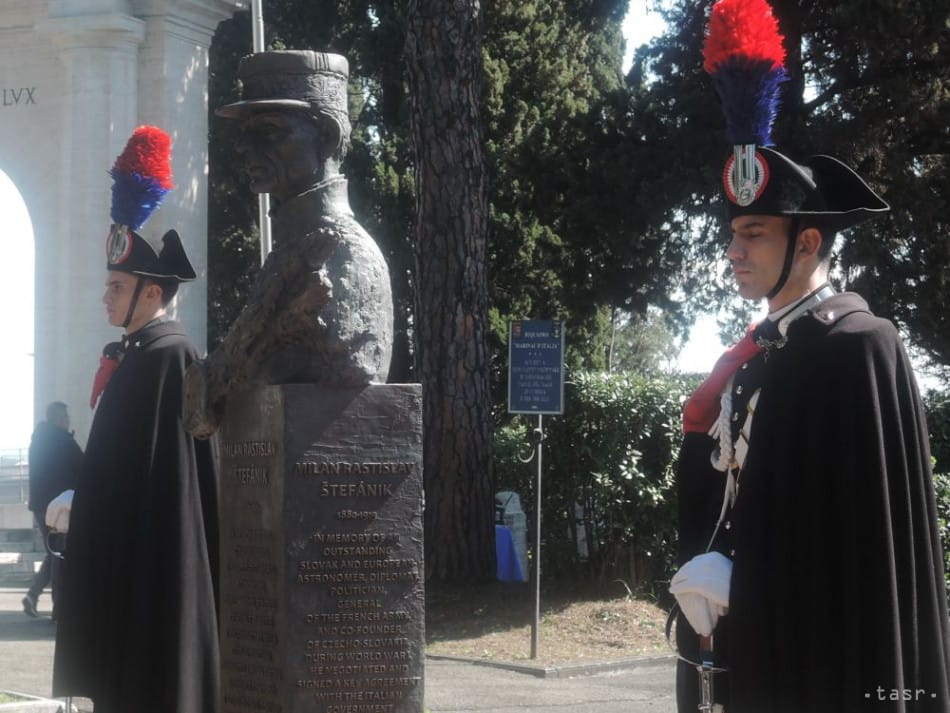
Rome, 19 March (TASR-correspondent) - General Milan Rastislav Stefanik was a figure of pan-European stature, emphasised Culture Minister Martina Simkovicova at the unveiling of his bust at the Verano Military Cemetery in Rome on Thursday.
The ceremonial event symbolises the historical ties between Slovakia and Italy, linked by Stefanik's personality and work.
"Milan Rastislav Stefanik was a scientist, diplomat, soldier and statesman who significantly transcended Slovakia's borders," said Simkovicova following the ceremonial unveiling of Stefanik's bust, pointing out that Stefanik played a significant role in the formation of an independent Czechoslovakia. In this context, she highlighted his successful diplomatic efforts in Italy in 1918.
"Thanks to Stefanik, Italy was the first country to recognise the formation of the Czechoslovak Legions as part of its armed forces and thereby de facto recognised the future independent Czechoslovak state," she noted. "For Slovaks, too, an independent state marked a historic turning point, the moment when they first became the bearers of state power on their own territory and fully realised the significance of the right to self-determination," she said, adding that the bust therefore expresses not only respect for the figure of Milan Rastislav Stefanik, but also reflects the connection and quality of Slovak-Italian relations.
In their speeches, Italian officials also praised the bilateral relations whose future was shaped by Stefanik. "His work inextricably linked our two nations," declared Federico Mollicone, chairman of the committee on culture, science and education of Italy's Chamber of Deputies. He views the unveiling of the bust as an opportunity to honour a great hero who wasn't only a diplomat, soldier and statesman. "He was also a visionary who was able to foresee the future of his nation," he said.
Italian Deputy Minister for Foreign Affairs and International Cooperation Edmondo Cirielli pointed out that soldiers of the Czechoslovak Legion also died in the First World War for the freedom and independence of Italy. He therefore emphasised not only the enduring value of mutual relations stemming from historical tradition but also Stefanik's moral legacy and unwavering struggle for freedom, which serves as universal inspiration for today's generations as well. "Whoever believes in their freedom is already free," he quoted Stefanik in this context.
Milan Rastislav Stefanik had a deep connection to Italy; in 1918, he played a pivotal role in setting up the Czechoslovak Army there and signed the first international treaty recognising it. During the First World War, he also served as a pilot on the Italian front. It was from the Italian airfield of Campoformido near Udine that he took off on 4 May 1919 on a journey home that ended in tragedy when his plane crashed near Ivanka pri Dunaji (Bratislava region).