Blanar Dismisses Migrant Claims, Slams Magyar Remarks
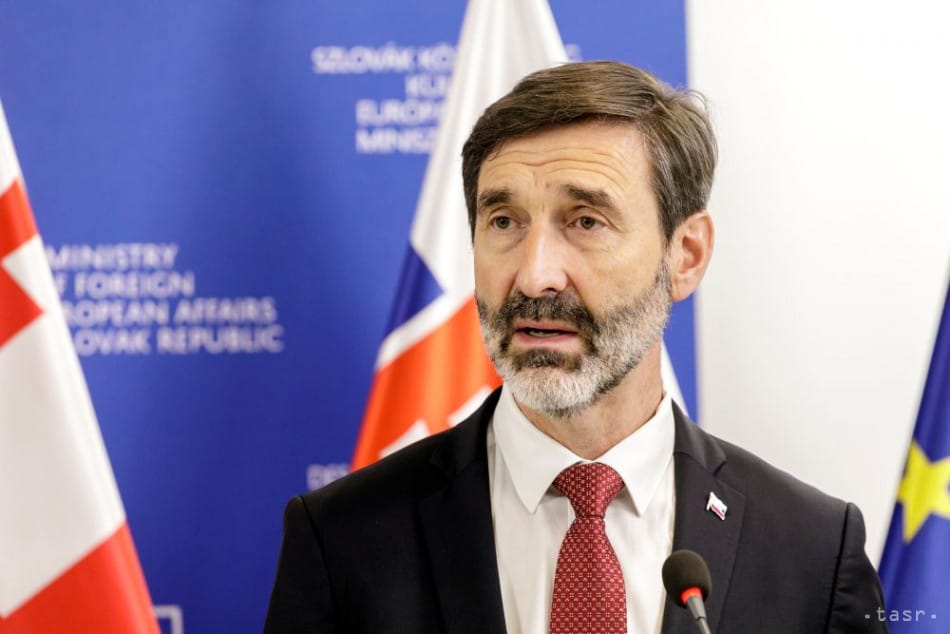
Bratislava, 16 April (TASR) – Claims about migrants being transported to Slovakia's borders before the 2023 parliamentary election are "as absurd as carrying water in a wicker basket", Slovak Foreign Minister Juraj Blanar (Smer-SD) said on Thursday at a parliamentary European Affairs Committee session.
Blanar also described as unacceptable remarks by Hungarian election winner Peter Magyar, who said he will serve as the prime minister of all Hungarians.
"According to my information, it is as absurd as carrying water in a wicker basket," Blanar declared in response to a question from committee member and leader of Progressive Slovakia Michal Simecka about alleged migrant transfers. The foreign minister questioned how such actions would benefit then-opposition Smer-SD leader and current Prime Minister Robert Fico, noting that Magyar has provided no evidence for his claims.
Blanar argued the allegation lacked logic, as Smer-SD was in opposition at the time while the government in office was allowing migrants into Slovakia.
"I have answered you," Blanar added when asked by Simecka whether he would summon the Hungarian ambassador over the matter.
Simecka said that if Magyar's statements were true, it would represent "an absolute scandal", and criticised the Slovak diplomacy for "refusing to respond".
Magyar said that, unlike current Hungarian Prime Minister Viktor Orban, he would not release 2,200 convicted migrant smugglers from Hungarian prisons. He also stated that "we will not bring migrants to the Slovak border if it were required by the interests of our 'social-democrat friend' in an election campaign".
Blanar stressed that Slovakia is a sovereign country that takes exemplary care of all national minorities, including the Hungarian minority. "Mr. Magyar's statement that he is the prime minister of all Hungarians in the Carpathian Basin is absolutely unacceptable to us," he told journalists.
"For the Hungarian minority in Slovakia and all citizens, under the Slovak Constitution, the prime minister is the one elected in (Slovak) elections," he added.
He was responding to reports that Magyar had invited Laszlo Gubik, leader of the non-parliamentary party Hungarian Alliance, to Budapest.
According to Blanar, Slovakia seeks good relations with Hungary but will wait for the formation of a new government before commenting further. He added that communication channels are open and the Slovak prime minister intends to engage with the likely future Hungarian premier, including on issues related to the Druzhba pipeline.
Blanar also addressed the issue of the so-called Benes Decrees. "We have adopted into our Criminal Code that if someone questions the Benes decrees, that is, claims they should not exist, it is a criminal offence, as it undermines the sovereignty and legal foundations of the Slovak Republic after the Second World War. But that does not mean these decrees cannot be discussed," he said.
"Questioning the Benes Decrees is an absolute red line for us. This is a fundamental pillar of our sovereignty,” he added.
Defence Minister and Deputy Prime Minister Robert Kalinak (Smer-SD) also commented on Magyar's statements during Thursday's parliamentary Question Time. He welcomed Magyar's position on strengthening the Visegrad Group (V4: Czech Republic, Hungary, Poland, Slovakia) but criticised his stance on the Benes Decrees.
"This issue could block cooperation within the V4, as it concerns not only Slovakia but also the Czech Republic," he said, accusing Progressive Slovakia of reopening the issue.
"If this becomes part of political competition, responsibility will lie with Progressive Slovakia, which actively opened it," he added.
Magyar said it was unacceptable for those who criticise the Benes Decrees to face imprisonment, adding that he believed most Slovaks shared this view.
Kalinak also addressed remarks about transporting migrants, suggesting they stem from inexperience. He pointed to differences between the migration situation in 2015 and in 2022–2023, noting that Hungary had stopped guarding its border with Serbia due to a dispute with the European Union, leading migration flows through Hungary towards Austria and Slovakia.
"The same happened in 2015, except that the government of Robert Fico prevented migrants from entering Slovakia, while the previous government of Eduard Heger allowed them in," he said, adding that this was the only difference.
He underlined that the migration issue did not help Smer-SD win elections. "It is an interesting political issue that can bring both gains and losses. But the previous government, which so damaged Slovakia, did not need any additional scandals," he added.