Event to Commemorate Occupation of Czechoslovakia in 1968 Held in Bratislava
Constitutional officials, representatives of other organisations and members of diplomatic corps gathered in front of the Comenius University building in Bratislava on Friday to commemorate the 58th anniversary of the start of the occupation of Czechoslovakia by Warsaw Pact troops.
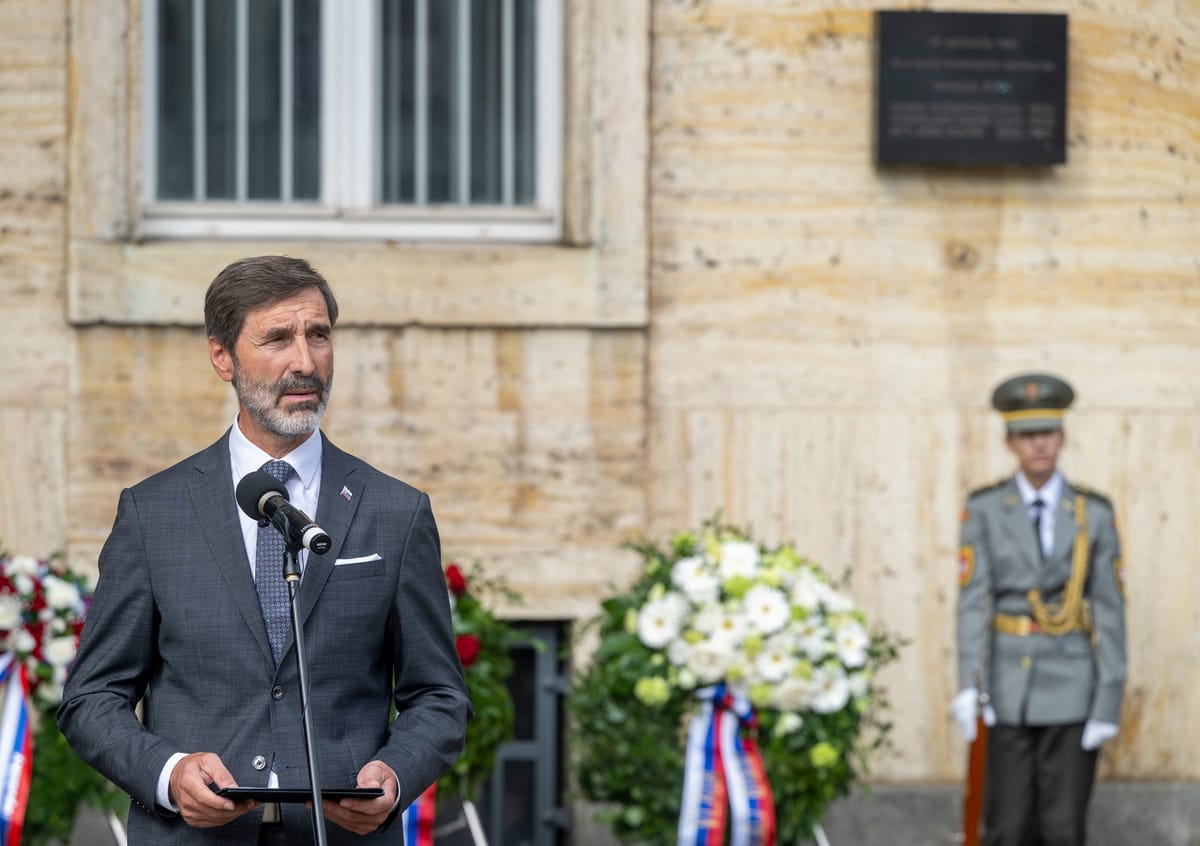
Bratislava, 21 August (TASR) - Constitutional officials, representatives of other organisations and members of diplomatic corps gathered in front of the Comenius University building in Bratislava on Friday to commemorate the 58th anniversary of the start of the occupation of Czechoslovakia by Warsaw Pact troops.
According to Foreign Affairs Minister Juraj Blanar (Smer-SD), who represented the Slovak government at the event, the arrival of the troops in 1968 provided no form of assistance, but rather began the occupation of a sovereign country.
"For us and for our statehood, the Slovak Republic, the legacy of August 1968 remains important today. The historical experience of 1968 has a clear international political dimension for us: international relations mustn't be based on the right of the stronger to decide the fate of the weaker. The fate of a country mustn't be decided by a foreign power through the use of military force. This isn't merely a lesson from the past; it's a principle that must remain a firm part of the international order," stated Blanar. According to him, the consequences of the invasion weren't merely political; there were also tragic consequences for the families who lost their loved ones.
House Vice-chair Martin Dubeci (Progressive Slovakia/PS) in his address drew parallels between the occupation of Czechoslovakia and the war in Ukraine waged by Russia.
President Peter Pellegrini, whose address was read out on his behalf by Colonel Richard Beniak, the commander of the President's Military Office, pointed out that beyond the individual victims, the invasion had other consequences.
Beniak began by defending the president's absence by pointing to his work schedule. In the address read out by Beniak, Pellegrini recalled that the invasion halted reforms aimed at creating 'socialism with a human face'. "Let's not allow freedom of speech to be confused with the spread of hatred or lies. August 1968 also demonstrates that political and power-related goals can never be achieved through violent means in the long term. However invincible the power of hundreds of thousands of troops in the occupying army may have seemed, the then totalitarian regime ultimately succumbed to society's call for freedom 21 years later," reads the address.
The commemorative event in centre of Bratislava was disrupted by two men who accused minister Blanar of collaborating with Russia. The police intervened after they began calling out. After the event, Blanar told the media that freedom of expression was also part of the message left by the victims of 1968. He stressed, however, that people should express their views in a civilised manner.