President Calls Referendum for 4 July on Only Two Questions
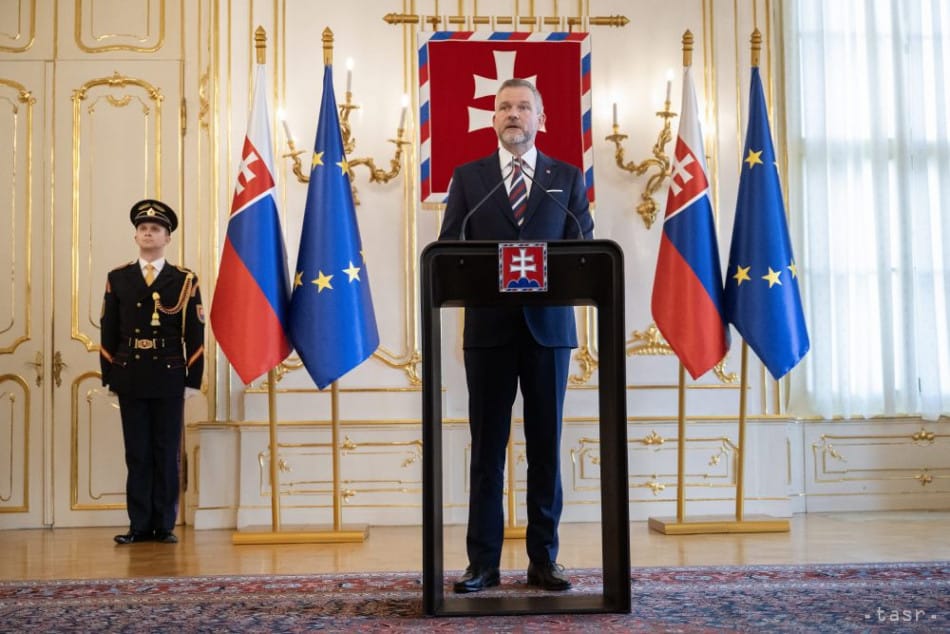
Bratislava, 20 April (TASR) – President Peter Pellegrini will call a referendum with two questions concerning the abolition of so-called lifetime annuities and the restoration of the Special Prosecutor's Office and National Crime Agency for 4 July.
A question on a request to shorten the electoral term will not be included in the referendum, with the head of state claiming that it would be in conflict with the Slovak Constitution.
Voters will decide on two questions: "Do you agree with the abolition of the so-called lifetime annuity; for example, for [Prime Minister] Robert Fico, established in Section 24a(1)(b) of Act No. 120/1993 Coll. on the salary conditions of certain constitutional officials of the Slovak Republic, as amended?" and "Do you agree that the Special Prosecutor's Office and the National Crime Agency should be restored?"
The proposed question deemed not to meet the conditions to be included read: "Do you agree that Parliament should adopt a resolution to shorten its ninth electoral term and set the date of early elections so that they are held within 180 days of the announcement of the referendum results?"
The president explained that his role is to assess whether the petition committee submitted a sufficient number of valid signatures and whether the proposal for a referendum meets constitutional requirements.
"A total of 384,512 signatures were completed and checked on the submitted sheets. Of these, the President's Office assessed 363,799 as valid and 20,713 as invalid. The number of signatures required to call a referendum was therefore met," Pellegrini said.
The legal team assessed the question on shortening the electoral term as unconstitutional. He noted that shortening the term is currently only possible through a parliamentary resolution.
"No other immediate way of shortening the ongoing electoral term of parliament is recognised by the Constitution in its current wording," Pellegrini added.
The president also pointed out that the issue of shortening the electoral term through a referendum had already been examined in detail by the Constitutional Court when former president Zuzana Caputova (2019-24) referred the matter to it.
"The Constitutional Court ruled explicitly in its decision of 7 July 2021 that a referendum cannot be used to shorten the ongoing electoral term of parliament. The court made this clear in several parts of its ruling, which I also quote verbatim in my written decision," Pellegrini said.
"In view of these clear verdicts, I did not consider it necessary to refer the same question to the Constitutional Court again," he added.
The president stressed that his position on the rejected question is based on expert legal assessment and is not influenced by political circumstances. He also referred to the views of several constitutional lawyers who share the same opinion.
Pellegrini added that if the Constitution were amended in the future to allow people to decide on shortening the electoral term, he would respect such a change.
"Because it would be fully in line with my civic and personal conviction on this matter. If the people grant power, they should also have the possibility to take it away from politicians at any time. However, after the Constitutional Court's ruling, this idea cannot be implemented today without a constitutional amendment," Pellegrini said.
He added that he has no doubts the other two questions are in line with the Constitution, although he warned that the question on restoring the Office of the Special Prosecutor and the National Criminal Agency is not directly enforceable.
"Its outcome may rather be a final and general legal norm. Whether this actually happens will depend on the free decision of members of Parliament. Even in the event of a valid referendum, this question will therefore have no direct enforceable effects," he explained.
According to the president, the date of 4 July was chosen to give citizens sufficient time to apply for postal voting. He noted that the legal deadline for registration is no later than 52 days before the referendum, giving a 23-day registration period. A shorter period, which would have resulted from setting the date a week earlier as proposed by the petition initiators, would have been insufficient.
The referendum was initiated by the extra-parliamentary Democrats party.
A referendum is called by the president if at least 350,000 citizens request it by petition. The Constitution also stipulates that referendum results are valid if more than half of eligible voters participate and if the decision is approved by a majority of those taking part.